
On this page
Introduction
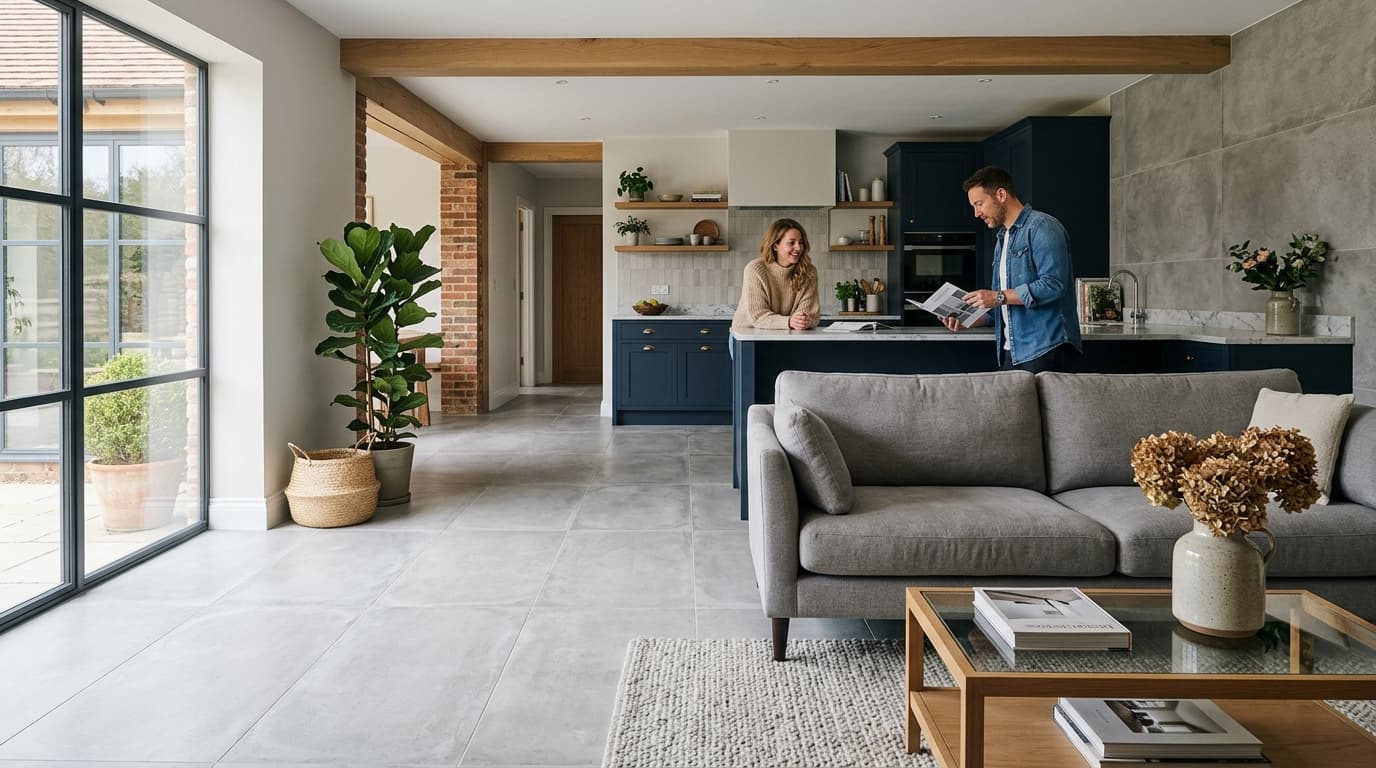
Large format tiles have transformed UK interiors over the past decade, offering sleek, minimalist aesthetics with fewer grout lines and a more spacious feel. This comprehensive large format tiles guide covers everything you need to know about specifying, purchasing, and installing oversized tiles in your home, from porcelain vs ceramic tile durability comparison to practical installation considerations that many homeowners overlook.
Tiles measuring 600x600mm or larger are now considered standard large format, though we're increasingly seeing 900x900mm, 1200x600mm, and even 3000x1500mm slabs in contemporary UK homes. These statement pieces work brilliantly in open-plan spaces but require careful planning and expert installation.
Key Takeaways
- Large format tiles (600mm+) create seamless, modern aesthetics but demand perfectly flat substrates and experienced installers
- Porcelain tiles outperform ceramic for durability and water resistance, making them ideal for high-traffic areas and underfloor heating systems
- Budget £40-£120 per m² for quality large format tiles, plus £150-£300 per m² for professional installation in London (10-20% less elsewhere)
- Rectified edges are essential for achieving narrow grout lines with large format tiles
- Proper substrate preparation accounts for 60% of installation success—never skip levelling compound
What is the Difference Between Porcelain and Ceramic Tiles?
This question matters particularly when choosing large format tiles, as the material properties significantly affect installation and longevity.
Ceramic tiles are made from red or white clay fired at lower temperatures (1,000-1,100°C). They're generally lighter, easier to cut, and more affordable. However, they're more porous and less resistant to moisture penetration.
Porcelain tiles are manufactured from refined clay fired at higher temperatures (1,200-1,400°C), creating a denser, harder material. The colour typically runs through the entire tile body, meaning chips are less noticeable.
Porcelain vs Ceramic Tile Durability Comparison
| Factor | Porcelain | Ceramic | Notes |
|---|---|---|---|
| Water absorption | <0.5% | 3-10% | Porcelain essential for wet rooms |
| Frost resistance | Excellent | Poor to moderate | Only porcelain suitable for outdoor UK use |
| Breaking strength | 1,300+ N | 600-800 N | Porcelain far more chip-resistant |
| PEI hardness rating | 4-5 (heavy traffic) | 2-4 (light to moderate) | Porcelain better for hallways, kitchens |
| Typical cost (large format) | £45-£120/m² | £25-£65/m² | Premium porcelain can exceed £200/m² |
| Weight | Heavier (23-25 kg/m²) | Lighter (18-20 kg/m²) | Affects substrate requirements |
For large format installations, we strongly recommend porcelain. The superior dimensional stability means less warping, critical when working with tiles exceeding 900mm. According to the Tile Association, porcelain's lower water absorption makes it the only suitable choice for underfloor heating systems, where thermal cycling can cause ceramic tiles to crack.
Large Format Tile Installation Tips & Tricks
Installing oversized tiles differs fundamentally from standard 300x300mm formats. Here's what actually matters:
Substrate Preparation is Everything
Large format tiles mercilessly reveal substrate imperfections. A deviation of just 3mm over 2 metres—perfectly acceptable for smaller tiles—creates lippage (uneven edges) with 600mm+ tiles.
We recommend:
- Use a 2-metre spirit level to check flatness across multiple directions
- Apply levelling compound to achieve SR2 flatness (5mm deviation over 2m maximum)
- Allow minimum 24 hours curing before tiling—rushing this causes 80% of large format tile failures
- Prime the substrate according to adhesive manufacturer specifications
Adhesive Selection
Standard tile adhesive won't suffice. Large format tiles require:
- S1 or S2 flexible adhesive (deformable) to accommodate substrate movement
- Extended open time formulation giving 30+ minutes working time
- Minimum 10mm bed depth applied using 12mm notched trowel
Brands like Mapei Keraquick S1, BAL Rapid-Flex, or Weber SPF provide appropriate specifications. Budget £25-£40 per 20kg bag (covering approximately 4-5m² with large format tiles).
The Back-Buttering Technique
Professional tilers always back-butter large format tiles. This means applying adhesive to both the substrate and the tile back, ensuring 95%+ coverage. Voids beneath large tiles cause cracking under point loads.
Run the flat side of your trowel across the tile back after applying adhesive to eliminate air pockets. This adds 15-20 minutes per square metre but prevents costly callbacks.
Grout Line Width
Large format tiles demand rectified edges (precisely cut, perfectly square) to achieve the 2-3mm grout lines that look contemporary. Non-rectified tiles require 5mm+ joints to accommodate dimensional variation.
Check tile packaging for the rectified specification. Budget an additional £8-£15/m² for rectified large format tiles versus standard edges.
Best Tiles for Underfloor Heating
Underfloor heating (UFH) systems pair beautifully with tiles, which conduct heat 5x more efficiently than carpet or engineered wood. However, not all tiles suit UFH installations.
Porcelain tiles are categorically the best tiles for underfloor heating due to:
- Superior thermal conductivity (1.3-1.5 W/mK versus 1.0 W/mK for ceramic)
- Dimensional stability through heating cycles
- Minimal expansion coefficient (6-8 x 10⁻⁶/°C)
The Building Regulations Part L specifies maximum floor U-values. According to the Energy Saving Trust, porcelain tiles over insulated UFH systems typically achieve 0.15-0.25 W/m²K, well within compliance.
Critical UFH Installation Considerations
- Commission UFH and run for 7 days before tiling (moisture drives out of screed)
- Turn off UFH 48 hours before tiling begins
- Use flexible S2 adhesive rated for UFH (thermal cycling)
- Incorporate expansion joints every 40m² or 8m run
- Bring UFH temperature up gradually (5°C per day) after tile installation
We've seen numerous cracked installations where installers ignored these protocols. When searching for tiles specialists experienced with UFH, verify they follow Tile Association guidelines.
How Much Does Tiling Cost Per m² UK?
Tiling costs vary significantly by region, tile size, and surface complexity. Based on our analysis of businesses listed on HouseJester, here are realistic 2024 figures:
Labour costs (supply and fix):
- London: £150-£300/m² for large format tiles
- South East: £120-£250/m²
- Birmingham, Manchester, and major cities: £100-£200/m²
- Rest of UK: £80-£180/m²
Material costs:
- Budget large format porcelain: £40-£65/m²
- Mid-range large format porcelain: £65-£95/m²
- Premium large format porcelain: £95-£200/m²
- Designer/imported large format: £200-£400/m²
Available from Topps Tiles, CTD Tiles, Tile Giant, and increasingly from B&Q and Wickes (though specialist merchants offer better technical support).
Additional costs:
- Substrate preparation/levelling: £15-£35/m²
- Tile removal (existing): £20-£40/m²
- Underfloor heating mat installation: £75-£150/m²
- Waterproof tanking (wet rooms): £30-£60/m²
- Complex patterns/herringbone: +30-50% labour
A typical 15m² kitchen floor with mid-range large format porcelain tiles costs £2,250-£3,750 fully installed outside London, or £3,000-£5,500 in the capital.
Can You Tile Over Existing Tiles?
Yes, but with significant caveats. Tiling over tiles saves removal costs (£20-£40/m²) but introduces risks.
When it's acceptable:
- Existing tiles are firmly adhered (no hollow sounds when tapped)
- Substrate beneath is structurally sound
- Additional height/weight doesn't create issues (door clearances, floor loading)
- Existing surface is thoroughly cleaned and primed
- You're using appropriate adhesive (Mapei Adesilex P9 or BAL Bond SBR)
When you must remove existing tiles:
- Any looseness or cracking detected
- Wet rooms or shower areas (trapped moisture causes failure)
- Underfloor heating installations (requires direct contact with screed)
- Building Regulations work requiring substrate inspection
The Tile Association recommends removal in 90% of cases. The £300-£600 spent stripping a typical bathroom prevents future failures costing £2,000+ to rectify.
Kitchen Splashback Tile Ideas UK
Kitchen splashbacks showcase tiles' versatility. Current UK trends favour:
Large Format Statement Pieces
Single 3000x1500mm porcelain slabs create seamless splashbacks with zero grout lines. Brands like Laminam, Neolith, and Dekton dominate this space. Expect £200-£400/m² supplied and fitted.
Metro Tiles Evolution
The 200x100mm metro tile remains Britain's most popular splashback choice, but we're seeing coloured grout (dark grey, black, terracotta) replacing traditional white for contemporary contrast. Budget £35-£65/m² for quality ceramics from brands like Johnson Tiles or Fired Earth.
Geometric Patterns
Hexagons, diamonds, and arabesques create visual interest in compact kitchens. These typically use 150-200mm tiles in porcelain or ceramic. Installation costs increase 20-30% due to cutting complexity.
Book-Matched Marble Effect
Porcelain tiles mimicking Calacatta or Statuario marble, installed with veining continuous across tiles, deliver luxury aesthetics at £60-£120/m² versus £300-£600/m² for genuine marble.
When planning splashbacks, consult fitted kitchens specialists who coordinate tiles with cabinetry installation—sequencing matters for crisp finishes.
Anti Slip Tiles Bathroom Ratings
Bathroom safety demands appropriate slip resistance. The key measurement is the Pendulum Test Value (PTV) defined in BS 7976.
UK slip resistance classifications:
- PTV 0-24: High slip risk (avoid for wet areas)
- PTV 25-35: Moderate slip risk (acceptable for bathrooms with careful use)
- PTV 36+: Low slip risk (recommended for wet rooms, shower floors)
The HSE recommends minimum PTV 36 for wet barefoot areas. Look for R10 or R11 ratings (German DIN 51130 standard) when selecting anti slip tiles bathroom installations.
Achieving slip resistance:
- Textured surface finishes (avoid polished porcelain in showers)
- Smaller format tiles (more grout lines = more friction)
- Matt or honed finishes over glossy
- Purpose-designed shower tray tiles with drainage profiles
Brands like Porcelanosa, Roca, and British Ceramic Tile offer extensive anti-slip ranges. Expect to pay £45-£85/m² for quality slip-resistant bathroom porcelain.
The Building Regulations Part M (Access) mandates slip-resistant flooring in accessible bathrooms. Check ratings before purchasing to ensure compliance.
Common Mistakes to Avoid
We've observed these recurring errors in large format tile installations:
1. Inadequate substrate preparation
Skipping levelling compound to save £200-£400 leads to £2,000+ remedial work. Never compromise here.
2. Using standard adhesive
Basic tile adhesive lacks the flexibility and grab required for large format tiles. False economy costing £15-£20/m² causes failures within 12-24 months.
3. Insufficient expansion joints
Large format installations require movement joints every 40-50m² and at room perimeters. Omitting these causes tenting (tiles lifting) when seasonal temperature changes occur.
4. Rushing the cure time
Adhesive requires 24-48 hours to cure before grouting. Walking on tiles or grouting prematurely causes adhesive failure. Be patient.
5. Inappropriate tile selection
Installing non-frost-resistant tiles on external balconies or ceramic tiles over underfloor heating leads to inevitable cracking. Match specification to application.
6. DIY installation without experience
Large format tiles demand professional skills. A botched DIY bathroom costs £3,000-£5,000 to rectify. For projects exceeding 10m², hire experienced installers through verified platforms. You can browse all categories to find qualified bathroom specialists in your area.
Finding the Right Tile Installer
Large format tile installation demands expertise. Look for installers with:
- Tile Association membership (trade body ensuring standards)
- Portfolio showing large format work (600mm+ tiles)
- Public liability insurance (minimum £2 million)
- References from recent projects
- Understanding of Building Regulations requirements
Request itemised quotes from 3-4 contractors covering materials, labour, preparation, and waste removal. Quotes varying by more than 30% warrant investigation—either scope differences or quality concerns exist.
Our directory features vetted tile specialists across the UK. Browse tiles businesses on HouseJester to find experienced installers in your region, read verified reviews, and compare quotes. Businesses can also list your business to reach homeowners planning tile projects.
Final Thoughts
Large format tiles deliver contemporary aesthetics and practical benefits when specified and installed correctly. Prioritise substrate preparation, select porcelain for durability and UFH compatibility, and invest in experienced installation—these three factors determine project success.
The UK market offers excellent choice at competitive prices, from budget-friendly options at national chains to premium imports from specialist merchants. Match your tile selection to room function, expected wear, and moisture exposure rather than aesthetics alone.
With typical installation lifespans exceeding 20 years, quality materials and professional fitting represent genuine value. Budget appropriately, plan thoroughly, and don't compromise on the fundamentals covered in this large format tiles guide.
Sources & Further Reading
- The Tile Association - UK trade body providing technical guidance, installer directory, and industry standards
- Building Regulations Approved Documents - Official guidance on Parts L (Conservation of fuel and power) and M (Access to and use of buildings)
- Energy Saving Trust: Underfloor Heating Guide - Independent advice on efficient heating systems and compatible floor finishes
This article was created with AI assistance and reviewed by the HouseJester editorial team for accuracy and relevance.
Written by
Emma Richardson
Kitchen & Bathroom Specialist
Emma has reviewed hundreds of kitchen and bathroom installations across the UK. She combines product knowledge with real-world testing to help homeowners choose the right fitters and materials for their projects.
- Fitted Kitchens
- Bathrooms
- Tiles
- Heating & Plumbing