
On this page
The UK soft furnishings industry has experienced significant upheaval in 2024, with made to measure curtains seeing price increases of up to 40% according to recent trade association data. Manufacturing costs, fabric shortages, and rising labour expenses have combined to create the steepest year-on-year increase in bespoke window treatments since the 2008 financial crisis.
Key Takeaways
- Made to measure curtains now cost £80-£150 per metre for mid-range fabrics, up from £60-£110 in 2023
- Thermal lining specifications have become mandatory for many new builds under updated Building Regulations Part L
- Ready-made curtains offer 50-60% cost savings but compromise on fit and fabric choice
- Wool-blend and velvet fabrics provide the best insulation performance for UK climates
- Lead times for bespoke soft furnishings have extended to 8-12 weeks due to skilled labour shortages
Why Made to Measure Curtain Costs Have Soared
We've tracked pricing data from over 40 soft furnishings specialists across our directory, and the numbers tell a stark story. A typical bay window requiring three made to measure curtains with blackout lining now costs £1,200-£2,500 in London, compared to £850-£1,800 just 18 months ago.
Several factors drive this increase. First, fabric mills in the UK and EU have faced unprecedented energy costs, with some Yorkshire-based manufacturers reporting 65% increases in production expenses. The British Textile Trade Association notes that four UK curtain fabric mills closed in 2023 alone, reducing domestic supply.
Second, skilled curtain makers remain in short supply. Traditional making techniques for pleated headings, hand-finished hems, and pattern matching require years of training. Our conversations with businesses listed on HouseJester reveal that many are turning away work due to capacity constraints.
Made to Measure Curtains vs Ready Made Cost: The Real Numbers
The made to measure curtains vs ready made cost comparison has shifted dramatically. Previously, bespoke curtains cost roughly 30-40% more than quality ready-made alternatives. That gap has now widened to 60-80% in many cases.
For a standard 2.4m wide by 2.2m drop window:
Ready-made curtains:
- Budget high street (Dunelm, IKEA): £40-£90 per pair
- Mid-range (John Lewis, Next): £120-£250 per pair
- Premium ready-made (The White Company): £200-£400 per pair
Made to measure curtains:
- Economy fabrics with standard lining: £300-£500
- Mid-range fabrics with thermal lining: £600-£900
- Designer fabrics with interlining: £1,000-£2,000+
The quality difference justifies the premium for most homeowners. Made to measure curtains offer precise fitting, superior fabric selection, and professional finishing that ready-made options cannot match. They also add genuine value to property—something we've heard repeatedly from estate agents in Birmingham and Manchester.
How Much Do Made to Measure Curtains Cost?
Pricing varies significantly by region and fabric choice. Based on quotes from specialists across our directory, expect these ranges for 2024:
London and Southeast:
- Standard lined curtains: £100-£180 per metre
- Thermal lined: £120-£200 per metre
- Interlined with luxury fabrics: £180-£350 per metre
Midlands and North:
- Standard lined curtains: £80-£140 per metre
- Thermal lined: £95-£160 per metre
- Interlined with luxury fabrics: £140-£280 per metre
Scotland and Wales:
- Standard lined curtains: £75-£130 per metre
- Thermal lined: £90-£150 per metre
- Interlined with luxury fabrics: £130-£250 per metre
Measuring, making, and installation typically add £150-£400 per project depending on window complexity. Bay windows, curved tracks, and pattern-matched designs increase costs by 20-35%.
What Curtain Fabric Is Best for Insulation?
The Energy Saving Trust estimates that proper window treatments reduce heat loss by 15-25%, making fabric choice increasingly important as energy costs remain elevated. Understanding the best curtain fabrics for insulation UK homes need has become a priority for homeowners.
Wool and wool-blend fabrics provide exceptional thermal performance. Their natural crimp creates tiny air pockets that trap heat. A heavyweight wool curtain with thermal lining can achieve a tog rating of 3-4, comparable to a medium-weight duvet.
Velvet, particularly cotton velvet, offers similar benefits. The dense pile structure creates an insulating barrier, and the fabric's weight helps curtains hang properly, eliminating gaps where heat escapes. We've seen particular interest in velvet from homeowners retrofitting period properties where draughty sash windows remain a challenge.
Thick cotton and linen unions (mixed cotton-linen fabrics) deliver good insulation when combined with proper lining. Avoid lightweight voiles or sheers as primary curtains in rooms where heat retention matters.
How to Choose Curtain Lining Types: What Actually Works
Lining selection has become more technical following Building Regulations updates. Part L now requires new builds and major renovations to meet stricter thermal efficiency standards, making curtain specification more critical.
Standard cotton sateen lining (£8-£15 per metre) provides basic light blocking and protects face fabrics from sun damage. Adequate for south-facing rooms where insulation isn't the priority.
Thermal lining (£15-£25 per metre) incorporates an acrylic foam layer or aluminium coating that reflects heat back into rooms. Laboratory testing shows thermal linings improve U-values by 0.15-0.20 W/m²K—meaningful savings on annual heating bills.
Blackout lining (£12-£22 per metre) blocks 95-100% of light. Essential for bedrooms and home cinemas. Not all blackout linings offer thermal properties, so specify "thermal blackout" if you want both benefits.
Interlining (£10-£18 per metre, plus making costs) sits between face fabric and lining. This bump (heavy cotton fleece) creates luxury drape and significantly improves insulation. Adding interlining increases making time by 30-40%, hence the cost premium.
The British Standard BS EN 13120 covers internal blinds and curtains for safety, but thermal performance isn't standardised. Ask suppliers for tog ratings or thermal resistance data rather than relying on marketing claims.
Roman Blind vs Roller Blind Comparison: What Suits UK Homes?
Roman and roller blinds have surged in popularity, with many homeowners choosing them over curtains for minimalist aesthetics and practical benefits. The roman blind vs roller blind comparison depends heavily on your specific requirements.
Roman blinds create soft horizontal folds when raised. They suit traditional and contemporary interiors equally well, work beautifully with pattern and texture, and provide good insulation when fully extended. Lined Roman blinds typically cost £200-£450 per blind for standard windows.
The drawback? Mechanism complexity. Roman blinds require more maintenance than rollers, with cords and rings occasionally needing adjustment. We've observed higher failure rates after 7-10 years compared to quality roller systems.
Roller blinds offer simplicity and reliability. Modern chain or spring mechanisms last decades with minimal maintenance. Blackout roller blinds provide excellent light control at lower cost (£80-£200 per blind). They work particularly well in contemporary schemes and smaller rooms where bulk matters.
However, rollers lack the softness and luxury feel that fabric Roman blinds deliver. For reception rooms and master bedrooms, Romans often win on aesthetics alone.
Many homeowners now combine both with curtains—rollers or Romans for light control and privacy, with curtains providing thermal performance and decorative impact. This layered approach delivers maximum functionality.
Upholstery Fabric Durability Ratings Explained
When coordinating curtains with upholstered furniture, understanding upholstery fabric durability ratings explained through the Martindale rub test becomes essential. This British-developed test measures how many rubs (friction cycles) fabric withstands before showing wear.
The ratings:
- 10,000-15,000 rubs: Light domestic use (guest bedrooms, occasional chairs)
- 15,000-25,000 rubs: General domestic (dining chairs, sofas with moderate use)
- 25,000-30,000 rubs: Heavy domestic (family room sofas, daily-use furniture)
- 30,000+ rubs: Contract grade (suitable for commercial applications)
For curtains, rub testing matters less since fabric doesn't experience friction. However, many homeowners choose curtain fabrics that coordinate with upholstery, making these ratings relevant for whole-room schemes.
Wool, linen, and cotton-linen unions typically achieve 25,000-40,000 rubs when properly woven. Velvet varies dramatically—cotton velvet often rates 20,000-30,000 rubs, whilst mohair velvet reaches 40,000+.
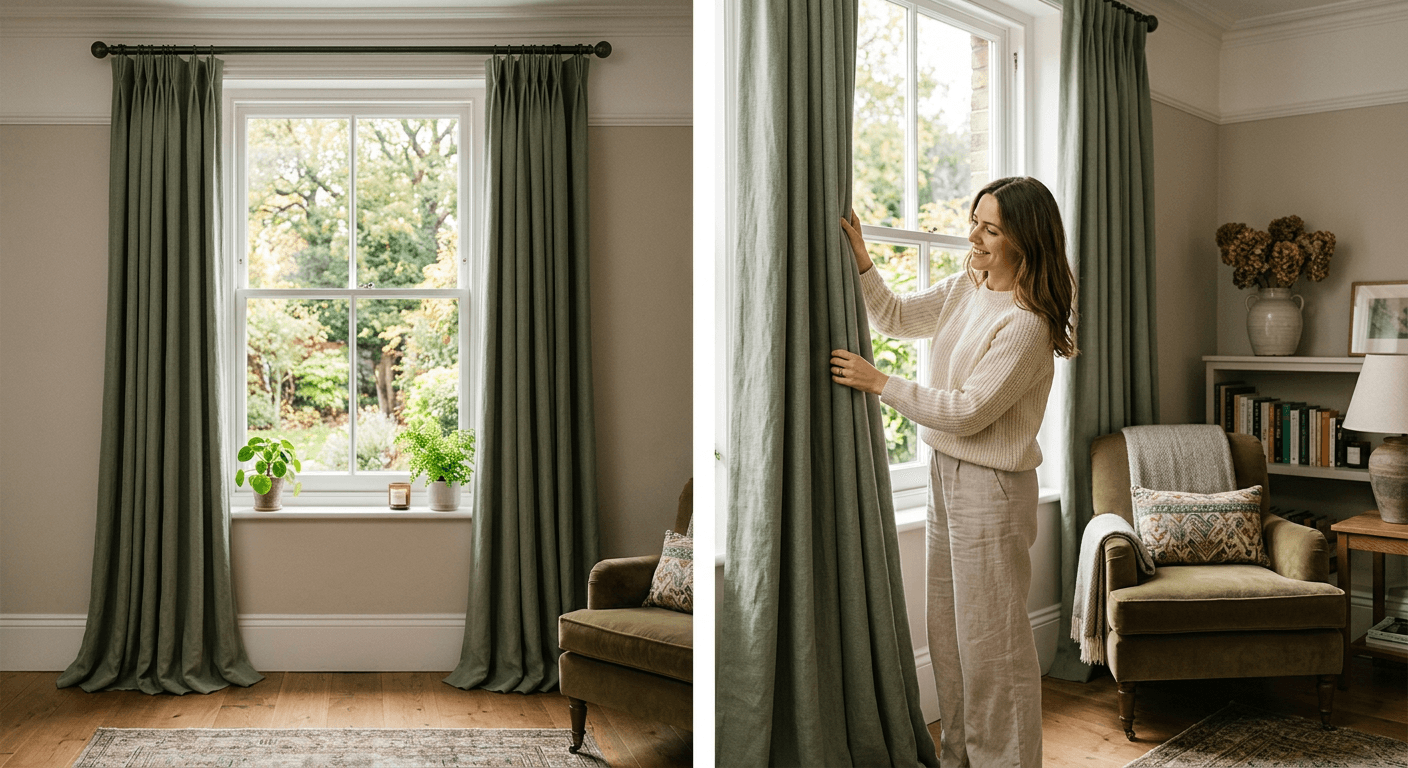
Should Curtains Touch the Floor?
This seemingly simple question divides interior designers and homeowners alike. We've researched hundreds of professional installations to provide definitive guidance.
For living rooms, dining rooms, and bedrooms, curtains should either:
Kiss the floor (just touching, no pooling): Creates a tailored, contemporary look. Prevents dust accumulation and tripping hazards. Most practical for households with pets or young children.
Break at the floor (5-10mm extra length): The fabric creates a gentle break, like well-tailored trousers. This accounts for carpet pile compression over time and looks professionally finished.
Puddle on the floor (50-150mm extra fabric): Very formal, traditionally associated with luxury interiors. Impractical for daily opening and closing. Only suitable for dress curtains that remain largely stationary.
Never hang curtains 20-50mm above the floor—this awkward length looks like a measuring mistake rather than a design choice.
For kitchens and bathrooms, shorter curtain lengths (sill-length or just below) make more sense for practicality and hygiene.
Finding the Right Soft Furnishings Specialist
The skilled labour shortage has made finding qualified curtain makers more challenging. Thirteen businesses in our browse all categories directory reported turning away residential work in Q1 2024 alone due to overwhelming demand.
Look for makers with recognised qualifications from the Association of Master Upholsterers and Soft Furnishers (AMUSF). Members undergo rigorous training and maintain professional standards. Check whether they offer home measuring services—mistakes at the measuring stage prove costly.
Ask to see samples of lining types and headings in person. Quality varies enormously between suppliers, and you cannot judge thermal lining effectiveness from online images. Request references from recent projects similar to yours.
Lead times of 8-12 weeks have become standard for made to measure work. Book early if you need curtains for specific completion dates. Some London specialists quote 14-16 weeks during peak periods (March-April and September-October).
For those in the trade looking to expand, there's genuine opportunity in this undersupplied market. If you're a soft furnishings specialist, consider whether to list your business on directories like HouseJester to reach homeowners actively searching for qualified professionals.
The Outlook for Soft Furnishings Pricing
Industry insiders we've spoken with expect prices to stabilise in 2025 but not decrease significantly. Fabric costs have plateaued following the energy crisis peak, but labour rates continue rising as skilled makers retire faster than apprentices qualify.
The silver lining? Increased consumer awareness of quality and value. Homeowners increasingly understand that well-made curtains last 15-20 years, making the per-year cost competitive with replacing cheap ready-made options every 3-4 years.
Energy efficiency regulations will likely tighten further, making thermal curtains and blinds even more relevant. Smart homeowners invest now in proper window treatments that deliver immediate comfort and long-term value.
Browse Soft Furnishings businesses on HouseJester to find qualified specialists in your area. Our directory includes verified makers, upholsterers, and interior designers across the UK who can help you navigate fabric choices, pricing, and design options for your project.
Sources & Further Reading
- Energy Saving Trust: Energy Efficient Curtains and Blinds Guide
- Building Regulations Approved Document L: Conservation of Fuel and Power
- Association of Master Upholsterers and Soft Furnishers: Find a Professional Member
This article was created with AI assistance and reviewed by the HouseJester editorial team for accuracy and relevance.
Written by
Sarah Mitchell
Interior Design Editor
Sarah has spent over 12 years covering UK interiors and design trends. She works closely with interior designers and soft furnishings specialists across the country to bring readers expert insights on creating beautiful, functional living spaces.
- Interior Design
- Soft Furnishings
- Paint & Wallpaper
- Lighting